
Why Memorizing Your Speech Backfires (2026)

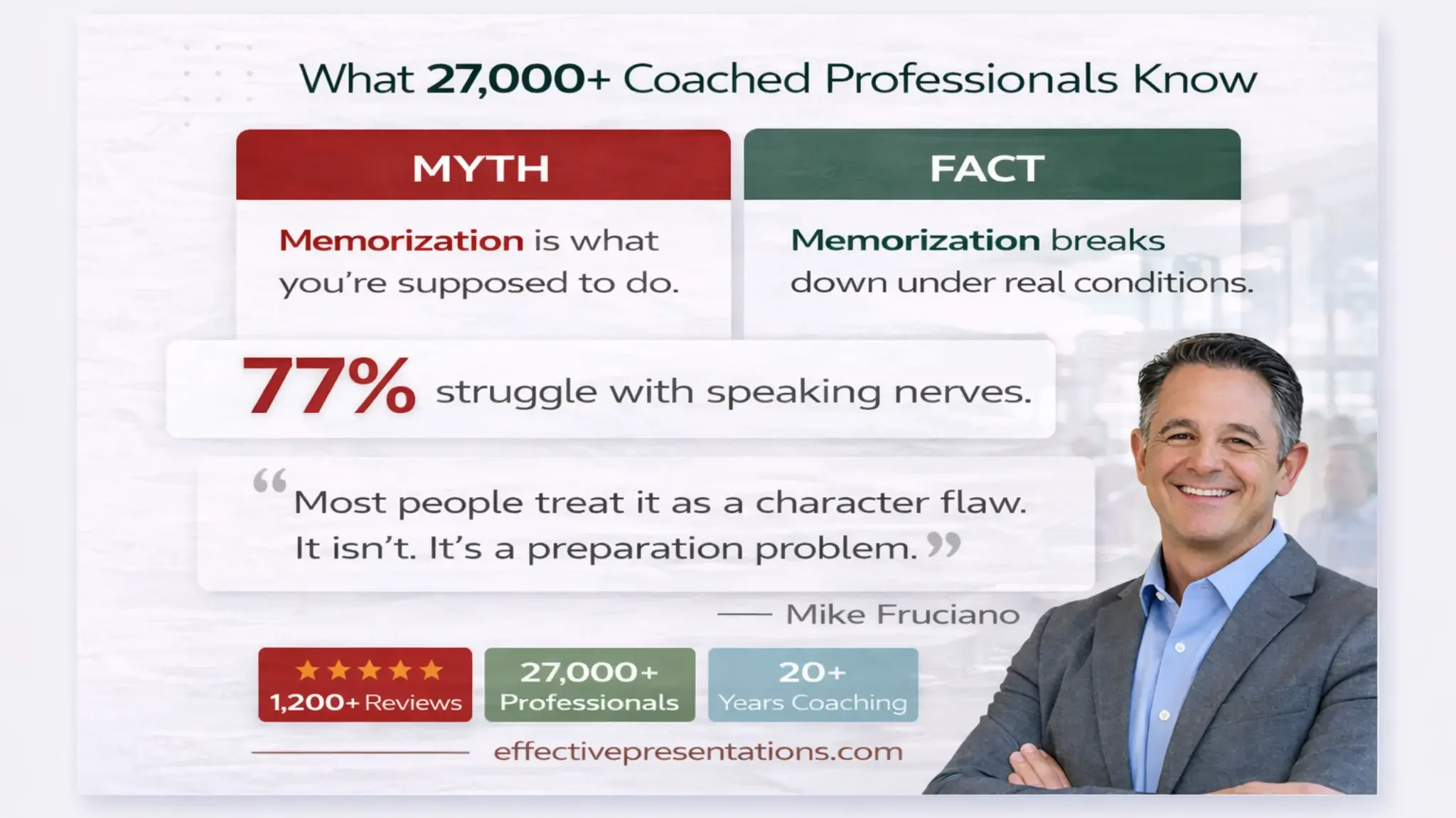
Every week, someone arrives at one of our public speaking workshops having spent days trying to lock their presentation into memory word for word. They know something is wrong. The delivery still feels stiff, the nerves are still there, and no matter how many times they run through the script, the confidence they expected never shows up. The reason is always the same: memorization is the wrong kind of preparation. It does not reduce anxiety. It increases it. It does not protect you from forgetting your material. It makes forgetting more likely. And when a memorized presentation does hold together, it sounds like exactly what it is: a recited script, not a real conversation. After 20-plus years coaching professionals at Apple, Microsoft, Monster Energy, and Sony, with more than 1,200 five-star Google reviews from people who have made this shift, we can tell you: memorization is one of the most reliable ways to undermine a presentation you are otherwise prepared to give.
Why Memorization Is the Wrong Kind of Preparation
Memorization feels logical. You are afraid of forgetting something, so you commit it to memory. The research, and the results we see across 100,000-plus professionals coached, consistently shows it is not the right kind of preparation.
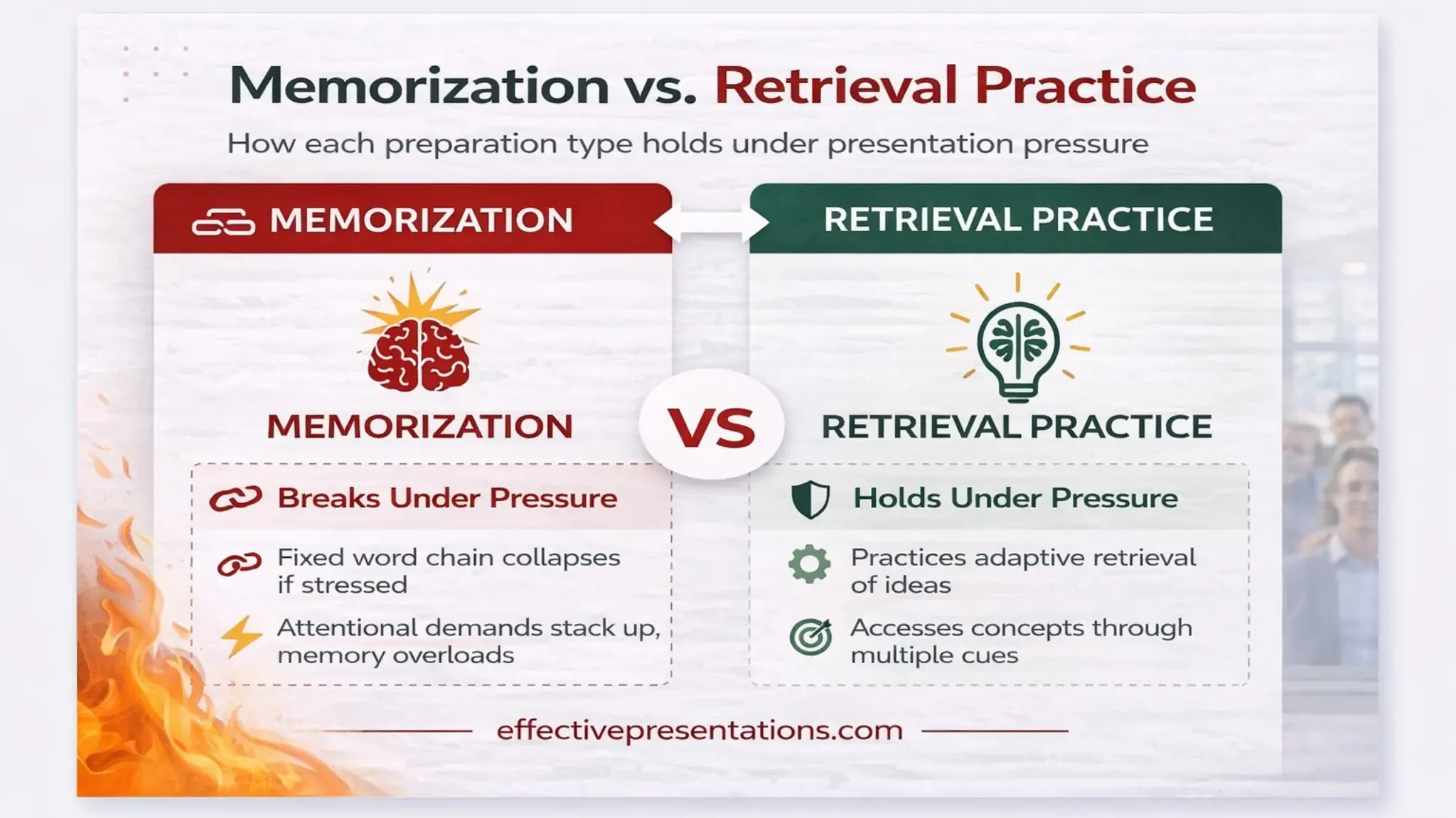
A landmark study in Psychological Science found that retrieval practice produces significantly stronger long-term retention and more reliable recall than rote memorization. The mechanism matters for presenters specifically. Memorization stores information as a sequential chain. Each word triggers the next. Break one link, whether that is a moment of nerves, an unexpected question, or an audience reaction you did not anticipate, and the entire chain snaps. You are not recalling ideas. You are retrieving a fixed sequence of words in a fixed order. That is a far more fragile cognitive task than knowing your material.
Stress makes it worse. Acute stress splits attentional resources between the emotional threat of being evaluated and the task of speaking. Research on anxiety and attentional control consistently shows that divided attention impairs verbal recall and working memory, which are the exact systems memorization depends on. Your memorized script is most vulnerable precisely when the stakes are highest and the room is full.
What Happens to Memorized Presenters in the Room
We have coached more than 100,000 professionals. The breakdown pattern for memorized presenters is almost identical every time.
The trouble starts in the first 90 seconds. The physiological stress response peaks early, working memory narrows, and a memorized presenter who is simultaneously trying to recall exact words while tracking the audience, managing their body, and monitoring their own performance runs out of cognitive bandwidth. A word disappears. Then the thought behind it. The presenter goes still. Every second of silence that follows is visible to everyone in the room.
Even when the memorized script holds together, it extracts a different cost. The presenter’s eyes go unfocused because they are listening inward for the next word. Vocal variety flattens because all available attention is going to retrieval. Gesture stiffens or disappears. These are not random signs of nerves. They are the physical signals of a person retrieving rather than thinking, and audiences read them immediately.
This is one of the primary reasons presenting feels so stressful even for professionals who have done it many times before. Memorization creates a dependency that turns every small deviation into a potential catastrophe, instead of the normal, manageable variation that skilled speakers absorb without breaking stride.
What to Do Instead: Concept Mastery Over Word Mastery
The professionals who consistently hold a room are not reciting. They are thinking.
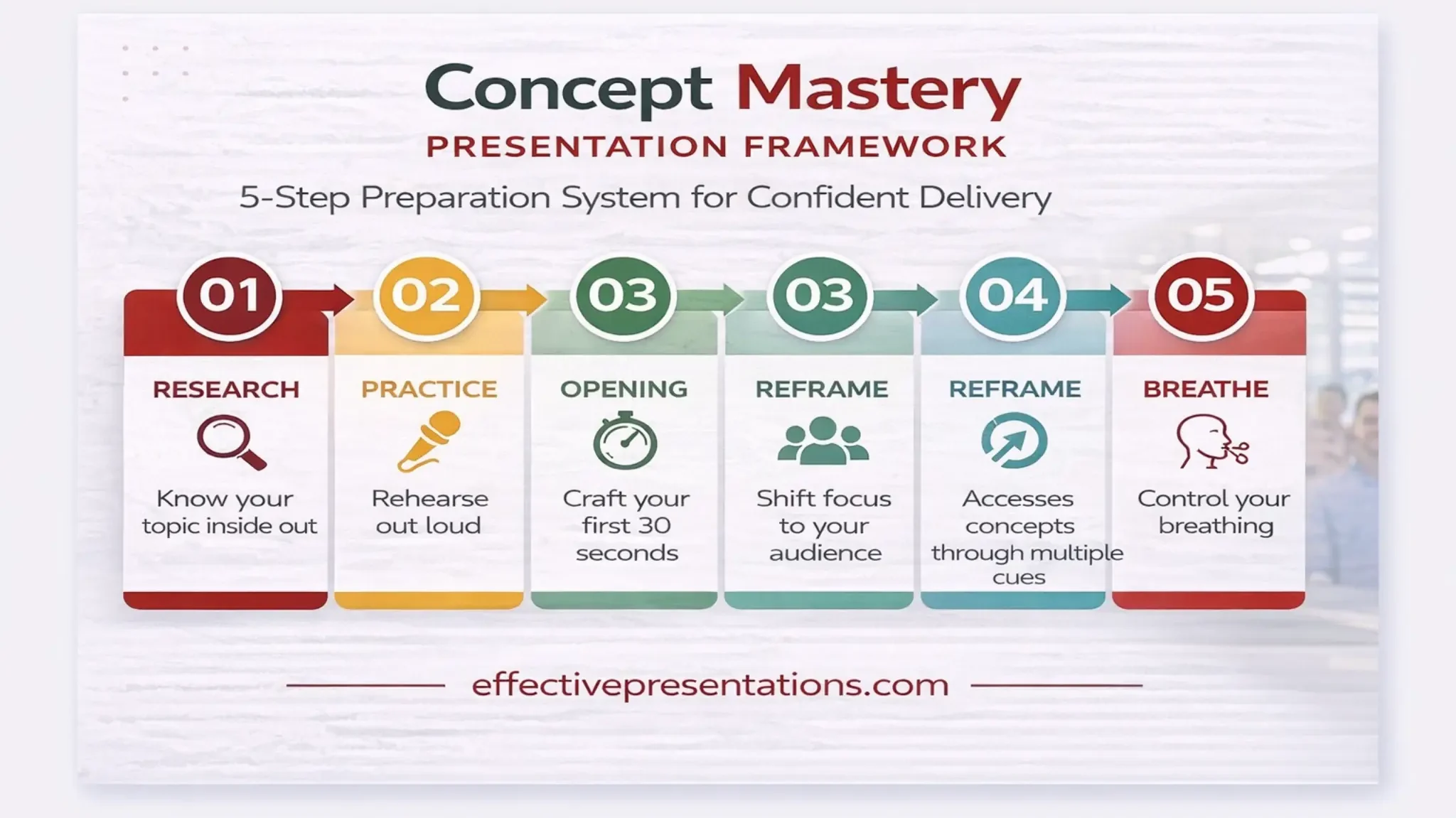
Concept mastery means knowing your material deeply enough that the right words generate themselves in the moment, rather than being retrieved from storage. Research by K. Anders Ericsson on expert performance established that expertise is built through deliberate practice: focused, feedback-intensive repetition of meaningful skills, not rote repetition of fixed sequences. The difference between a skilled presenter and a memorized one is the same as the difference between a musician who has internalized the theory and one playing from a recording. One adapts in real time. The other is locked to the track.
In our hands-on presentation coaching, concept mastery preparation works like this: know your three to five core points cold. Know the evidence behind each one. Know the stories you will tell. Know your section transitions. Then rehearse delivering all of it in real conditions: standing, at full volume, with physical delivery, until those elements flow naturally in whatever words feel right in the moment.
This preparation is harder than memorization. It requires more repetitions, genuine understanding of your material, and the discipline to rehearse delivery rather than recite script. What it produces is a presentation that absorbs a live question, an interruption, or an unexpected audience reaction without losing its thread.
The Only Two Things Worth Memorizing
There are exactly two exceptions: your opening and your close.
Your opening is the highest-anxiety window of any presentation. The stress response typically peaks within the first few minutes before beginning to subside. If you know your first 60 to 90 seconds absolutely cold, not roughly but cold, you give your nervous system a window to settle before the rest of the presentation has to carry the load. Knowing how to open a presentation with a fully committed first 90 seconds is one of the highest-leverage skills in public speaking. It gets you through the most dangerous window before the audience has formed a judgment.
Your close is where your presentation earns its outcome or loses it. A weak closing signals to every person in the room that the presenter ran out of material or confidence before the finish. Know exactly how you intend to end. A closing that lands drives action. One that trails off erases what came before it.
Everything between opening and close is guided by structure, not script. Know your sections. Know your points within each section. Know the transitions. Deliver them in whatever words feel right in the room on that day.
What Rehearsal Actually Looks Like
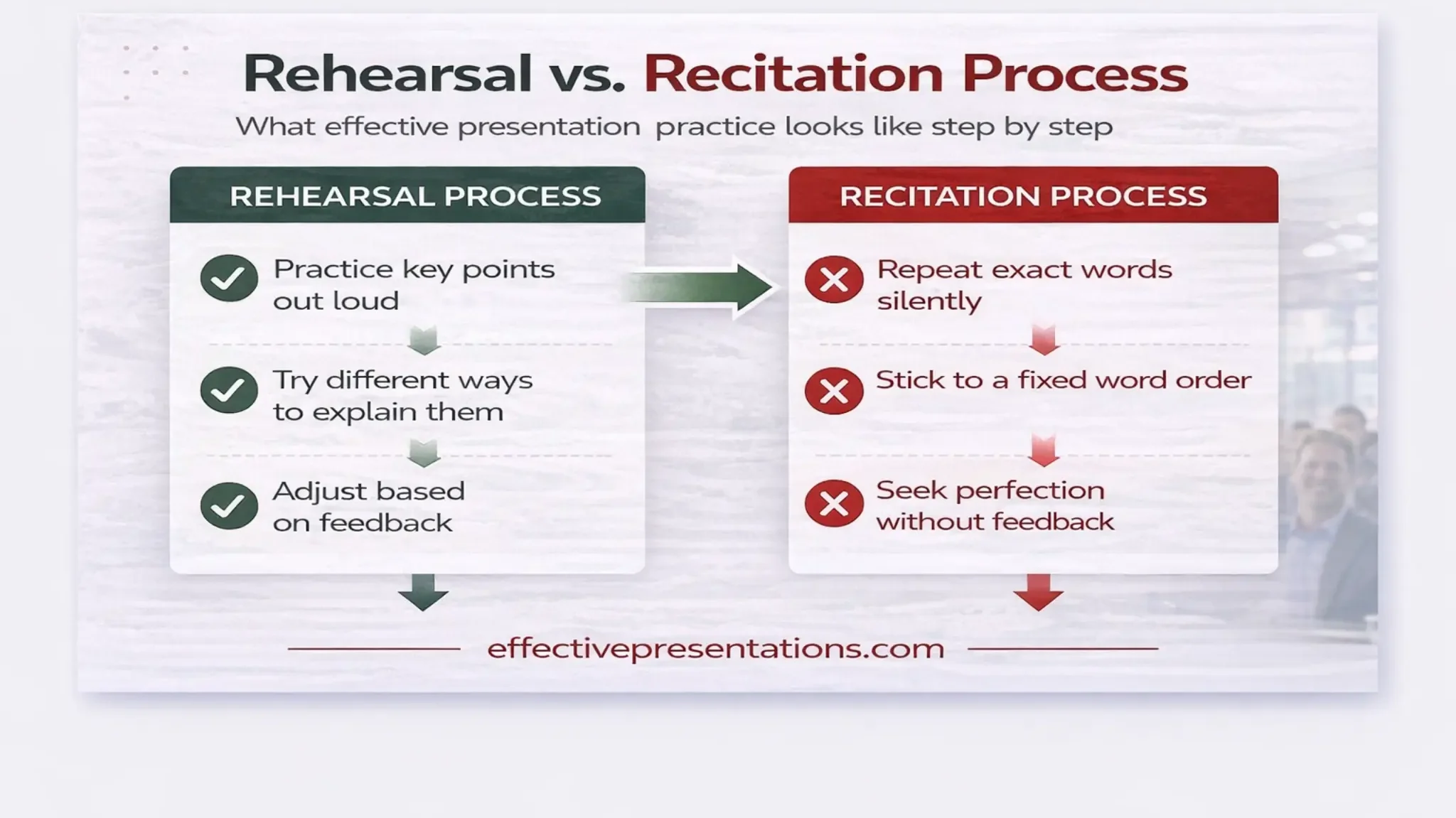
Rehearsal is not recitation. This distinction is worth being direct about.
Recitation is reading your script aloud until you no longer need to look at it. Rehearsal is running your presentation in conditions as close to real as possible: standing, at full volume, with physical delivery and eye contact to a real or imagined audience, with full attention on communication rather than word retrieval.
We teach presenters to rehearse with deliberate attention to vocal variety and physical presence rather than textual accuracy. You are drilling the skill of being present in the room. After enough real-conditions rehearsal, certain phrases will naturally repeat. You will say some things the same way every time. That is fine. What you want to avoid is treating any single phrase as a load-bearing wall the entire structure depends on.
The practical test is simple: lose a word mid-rehearsal and continue without restarting. If you can hold the point without the exact word, your preparation is working. If you freeze or go back to the beginning, you are still memorizing.
Alongside better rehearsal, it is worth addressing the anxiety that drives people toward memorization in the first place. We cover that in our guide on overcoming stage fright, and the short answer is that stronger concept-based preparation is itself one of the most effective anxiety management strategies available.
One Real Example
We coached a marketing director preparing a 20-minute quarterly review for a company-wide audience. She had spent three weeks memorizing the script. She arrived at our workshop certain she was ready. In the first out-loud rehearsal with a coach, she hit a wall in the second section, stopped, and restarted from the beginning of that section.
We did not fix her memory. We rebuilt her preparation. Over two days, she moved from a memorized script to five clear points, evidence for each, stories drawn from real work she had done, an opening she owned cold, and a close she had chosen deliberately. She kept almost nothing from the original script.
She delivered that presentation three weeks later without losing a single thread. When an executive asked a question mid-presentation, she answered it, connected the answer back to her third point, and continued without any visible adjustment. The audience saw nothing because there was nothing to see. She was thinking, not retrieving.
If you want to make that shift in a structured environment with live coaching and video feedback, our public speaking training program is built specifically for that purpose.
Frequently Asked Questions: Memorizing a Speech
Is it ever okay to memorize your speech?
Memorize your opening and your closing only. These are the two critical anchors of any presentation and the moments of highest anxiety for most presenters. Locking them down gives your nervous system a window to settle at the start and ensures your ending lands with intention. Everything in between should be guided by concept mastery and structure, not word-for-word recall.
What should I do instead of memorizing my speech?
Build concept mastery. Know your three to five core points and the supporting evidence for each. Know the stories you will tell and the transitions between sections. Then rehearse delivering your material in real conditions: standing, at full volume, with physical delivery, until the ideas flow naturally in whatever words feel right in the moment.
Why does a memorized speech sound robotic?
Memorization routes cognitive attention toward word retrieval rather than audience engagement. A presenter retrieving a script cannot simultaneously listen to the room, vary their vocal delivery, and respond to what they are seeing in real time. The result is flattened vocal variety, unfocused eye contact, and stiff gesture. These are the signals that tell an audience they are watching a performance rather than participating in a conversation.
How many times should you rehearse a presentation?
Most professionals need a minimum of five full run-throughs in real conditions before a high-stakes presentation. What matters is not the count but the quality: you are rehearsing delivery and concept recall, not reciting script. A well-rehearsed presenter who loses a word continues without restarting. A memorized presenter who loses a word may not be able to.
What is the connection between memorization and presentation anxiety?
Memorization increases anxiety rather than reducing it. It creates a dependency where any deviation, a question, a noise, a moment of nerves, feels like catastrophic failure. Concept-based preparation reduces anxiety because it gives you something more resilient to fall back on: your understanding of the material, not a chain of words. If anxiety is your primary challenge, read our guide on overcoming the fear of public speaking.
