
How to Overcome Speech Anxiety Before It Costs You the Room
75% of professionals experience it. Most never fix it. Not because it can’t be fixed, but because they’re treating the wrong problem.
Speech anxiety is not a confidence deficit. It is not evidence you’re wrong for this work. In thirty years of coaching, from Zig Ziglar sales floors to board rooms at Apple, Microsoft, and Sony, I have watched technically brilliant people collapse in front of a room and average presenters command one. The separating factor was never talent. It was always preparation depth and five specific mechanics.
Here’s the piece most programs miss: nervousness before a presentation is normal. What happens in the 48 hours before and the 60 seconds before you walk in. That determines whether anxiety consumes your delivery or disappears by your second sentence.
What Is Speech Anxiety?
Speech anxiety is the physical and psychological stress response triggered by anticipating judgment in front of an audience. Symptoms include racing heart, shallow breathing, mental blanking, and vocal tightening. It is not a permanent condition. It responds directly to preparation depth, physical anchoring, and deliberate low-stakes practice.
This Is a Preparation Problem, Not a Confidence Problem
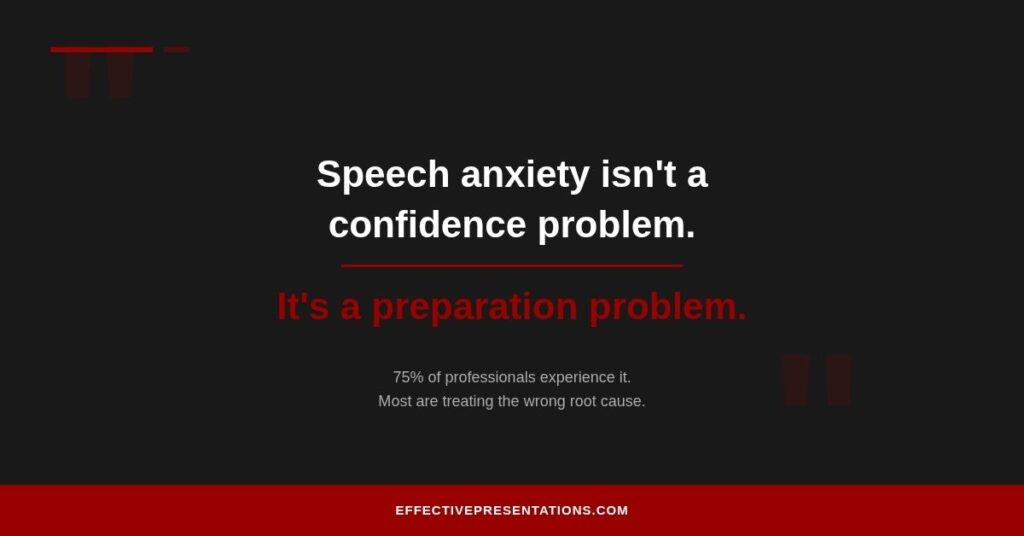
The first mistake: treating speech anxiety as a confidence problem. So people repeat affirmations, visualize success, pump themselves up backstage.
Then twelve faces stare back at them and it evaporates.
Confidence isn’t the foundation. Preparation is. Confidence is what you feel when you know the material cold, you’ve rehearsed your opening out loud three times, and you’ve already answered the hardest question someone might throw at you. It follows mastery. It doesn’t precede it.
I worked with a regional sales director at Monster Energy. Sharp, credible, completely effective one-on-one. In front of twenty people she locked up. We didn’t work on her mindset. We worked on her preparation process. Six weeks later she presented to a national leadership group without a stumble. One thing changed: how thoroughly she owned the material before she walked in.
5 Mechanics That Break the Anxiety Cycle
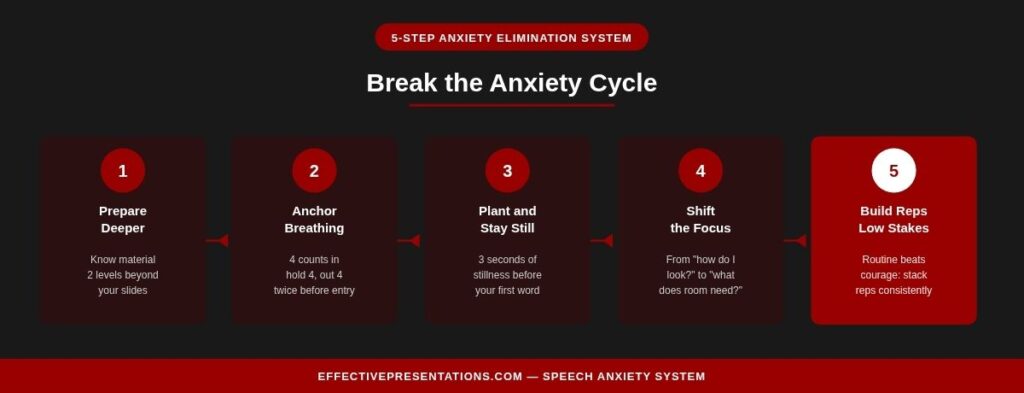
1. Prepare two levels deeper than your slides show
Know your material beyond what’s visible on screen. If your presentation covers three strategies, you should be able to speak for ten minutes on each without a slide in sight. That depth creates psychological safety. What the audience reads as composure is a speaker who has nothing left to hide.
2. Reset your nervous system before you walk in
In the 60 seconds before you present, breathe in for four counts, hold for four, out for four. Do it twice. This activates the parasympathetic nervous system and measurably drops your heart rate before your first word. It’s not metaphor. It’s a physiological intervention. How your voice changes under pressure explains exactly what this step is protecting.
3. Plant your feet and hold still for three seconds
The moment most anxious presenters reach the front, they start moving. Pacing. Fidgeting. Adjusting notes. It looks nervous because it is, and it locks in the anxiety by signaling to your own brain that something is worth fleeing.
Plant both feet. Set your posture. Hold still for three full seconds before your first word. That pause tells your nervous system the situation is under control. It tells the room the same thing.
4. Replace “how do I look?” with “what does this room need?”
Speech anxiety peaks when focus is self-directed: Am I stumbling? Does the CFO look bored? Did I just lose my place? One question breaks that loop: What does this specific room need to believe when I’m done? That becomes the only job. Self-evaluation is no longer on the list. How you frame your presentation method at the outset determines whether attention lands on audience impact or personal performance.
5. Build reps before the stakes are high
Courage doesn’t eliminate anxiety. Reps do. The more times you’ve stood up and delivered, in a team meeting, a workshop, in front of three colleagues, the more your nervous system files “speaking in front of people” under routine rather than threat. Public speaking training structured around feedback and repetition compresses what would otherwise take years into weeks. The reps matter more than where you get them.
Three Myths That Make Anxiety Worse
The audience is cataloguing every mistake. They’re not. Most errors the speaker notices, the room doesn’t. Audiences want a good presentation. They’re hoping you succeed before you open your mouth.
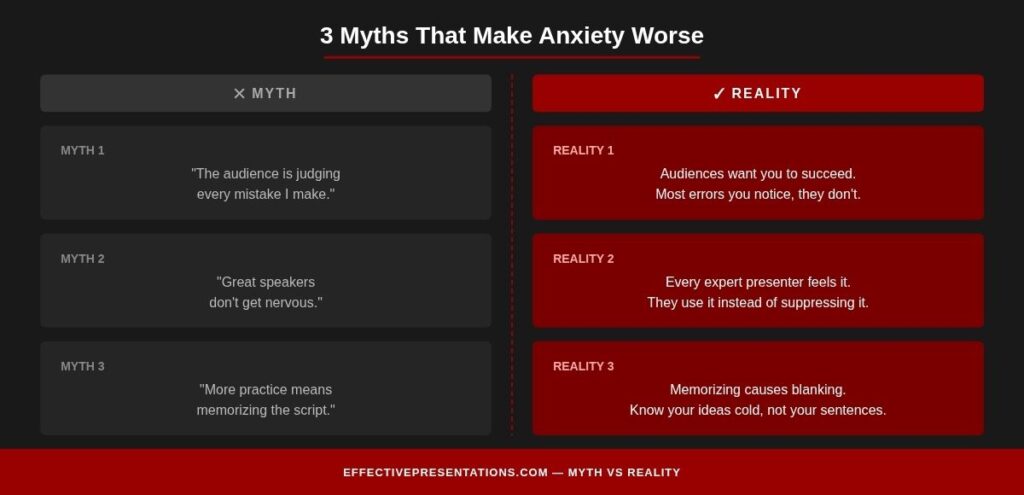
Great speakers don’t get nervous. Wrong. Every credible presenter I’ve coached who has stood before thousands still feels pre-performance energy. The difference is they’ve learned to use it rather than suppress it.
More preparation means memorizing the script. Memorizing is the fastest path to blanking under pressure. Forget one word and the whole structure collapses. Know your ideas cold, not your sentences. There’s a direct reason why memorizing your speech backfires is one of the first concepts we cover with every client.
What Long-Term Resilience Actually Looks Like
One presentation where it goes well doesn’t eliminate speech anxiety. A track record does.
That means building a practitioner’s habit: after every presentation, identify one thing that worked and one thing to adjust. Not a performance review. A brief, specific log. What did the room respond to? What fell flat? Stack those adjustments over six months and the shift is structural, not situational.
I’ve coached VP-level leaders at Sony who went from dreading quarterly town halls to requesting more speaking opportunities. Not because anxiety disappeared. Because competence replaced it. The progression from presentation fear to leadership presence follows a clear arc, but only when each presentation becomes a data point rather than a verdict.
For professionals in high-stakes environments, investor reviews, board presentations, and media appearances. executive coaching builds that track record faster than any group program can.
Frequently Asked Questions About Speech Anxiety
What causes speech anxiety?
Speech anxiety is triggered by the anticipation of judgment in a public setting. The most common root is a mismatch between preparation depth and perceived stakes. When someone feels their material isn’t fully owned, or lacks experience with the format, the brain treats the presentation as a threat. The fix is preparation and specific mechanics, not reassurance.
How do I stop shaking when I present?
Physical symptoms (shaking, racing heart, sweating) are physiological responses to perceived threat. The most effective interrupt is controlled breathing (4 counts in, hold 4, out 4) before you walk in, combined with deliberate stillness in the first ten seconds. These mechanics signal safety to your nervous system before your brain fully processes the situation.
How long does it take to overcome fear of public speaking?
With structured practice and feedback, most professionals see measurable improvement within four to six presentations. Building full composure under high-stakes conditions typically takes three to six months of consistent reps. The timeline compresses significantly with targeted presentation skills training.
Does speech anxiety ever fully go away?
For most people, pre-performance energy remains, but it stops functioning as anxiety. It becomes activation. The goal isn’t to eliminate the feeling; it’s to build enough competence that the feeling no longer impairs your delivery. Most experienced presenters wouldn’t want it completely gone.
What is the difference between stage fright and speech anxiety?
Stage fright is acute performance anxiety that appears immediately before or during a presentation. Speech anxiety is the broader pattern: anticipatory dread, avoidance behavior, and physical symptoms that can appear days before the event. Both respond to the same preparation-and-mechanics approach.
Where do I find low-stakes practice opportunities?
Team meetings, internal briefings, and workshop settings are the most accessible entry points. The goal is frequency, not dramatic stakes. Start where speaking is already routine and build incrementally. Review how the best training programs sequence that exposure. It follows a deliberate progression, not a random one.
The mechanics that eliminate speech anxiety are the same ones that build authority in a room. They don’t require a different personality. They require a preparation system, deliberate reps, and a coach who’s been on the other side of that fear.