
Best Public Speaking Training Programs to Build Confidence and Clarity (2026)

The best public speaking training programs help you do three things: overcome nervousness, communicate your ideas clearly, and speak with confidence in front of any audience. If you are leading meetings, presenting to clients, speaking at conferences, or interviewing for a new role, strong communication skills can make a significant difference in your professional success.
Approximately 77% of the general population experiences some level of fear around public speaking, according to research published in Neuropsychiatric Disease and Treatment. That number has held steady for decades. It is not going away on its own. What changes is whether professionals decide to do something about it, and what they choose to do when they do.
After 20-plus years coaching more than 100,000 professionals at Apple, Microsoft, Monster Energy, Sony, and organizations across the country, with more than 1,200 five-star Google reviews from people who walked in terrified and walked out in command, we have a clear view of what separates public speaking training programs that produce lasting improvement from those that produce a certificate and a forgotten weekend.
This guide gives you that view.
What a Good Public Speaking Training Program Actually Delivers
Most people looking for public speaking training want two things: to feel less afraid and to be more effective when they stand in front of a room. Good programs deliver both. The question is how they do it.
Research by K. Anders Ericsson on expert performance established that expertise in any performance skill is built through deliberate practice: structured repetition with specific feedback in conditions that progressively challenge the performer. That principle applies directly to public speaking. Programs that give you frameworks and send you home to “practice on your own” are delivering information, not building skill. Those are not the same thing.
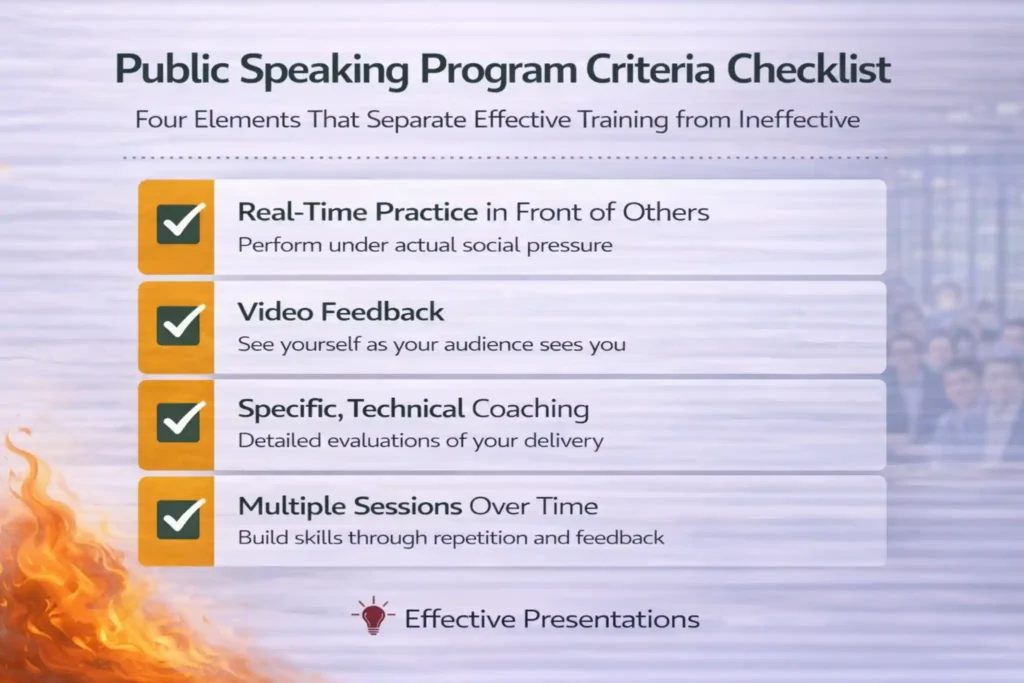
Four elements separate programs that work from programs that do not:
- Real-time practice in front of others. Your nervous system needs to learn to perform under actual social pressure, not a quieter simulation of it. Practice alone in your living room does not prepare you for a room of 200 people.
- Video feedback. Most presenters have no accurate perception of what they look like on their feet. Video closes that gap faster than any other single tool. Seeing it once does more than hearing about it twenty times.
- Specific, technical coaching. Not “be more confident.” Specific diagnosis: where the voice drops, when the hands freeze, what sentence structure is losing the audience before you reach your key point. Observation plus prescription.
- Multiple sessions over time. Single-day programs create awareness. Repeated coached practice over multiple sessions builds habits that hold under actual pressure.
What We Offer at Effective Presentations
We built Effective Presentations on one premise: the skill to do comes from the doing. Not from watching a video. Not from reading a framework.
From standing in front of a real room, getting specific feedback on exactly what is not working, and doing it again until the delivery changes.
That is the model we have run for more than 20 years. It is what produced 1,200-plus five-star Google reviews. It is what brought professionals from Apple, Microsoft, Monster Energy, and Sony into our workshops.
And it is what has put more than 100,000 coached professionals back in front of their rooms presenting differently than when they walked in.
Here is how we deliver it.
1. Workshops: Onsite, Virtual, and Open Enrollment
Our public speaking training come in three formats to fit how your team works. We deliver onsite at your location, anywhere in the United States, so your people practice in a real room with a real audience of colleagues.
We deliver virtually in live format with cameras on, full delivery coaching, and real-time feedback. And we run open enrollment workshops for individuals who want a cohort experience with professionals from other organizations. Every format includes individual coaching during the session.
You do not sit and watch. You stand up, present, get coached on what the audience is actually seeing, and present again.
2. 1-on-1 Coaching
For professionals with a specific high-stakes presentation coming up, a job interview, a board presentation, a keynote, our 1-on-1 coaching works through your actual material in your specific context.
This is not generic public speaking advice. It is your content, your audience, your delivery, coached until the presentation performs.
3. Executive Coaching
Senior leaders carry different communication demands. A VP presenting to the board, a CEO addressing the company during a transition, a leader whose presence is the brand in every room they walk into.
Our executive coaching is built for this tier, with coaching that matches the weight of the situations you are facing.
4. Corporate Team Training
When the whole team needs to present better, from the sales force to the technical leads, our corporate training programs address the full organization.
We have delivered this for Fortune 500 companies across industries. The result is not a team that attended a workshop. It is a team that presents differently in front of clients, leadership, and each other.
For teams that specifically need to strengthen how they present to clients, boards, and leadership, our business presentation skills training delivers that focus across the whole group with individual coaching for each presenter.
What makes it all work is specificity. Not “be more confident” but “your voice drops at the end of every declarative statement, and your hands freeze when you hit the data slide.” That level of diagnosis, combined with video review and immediate coached reps, is what produces lasting change.
The 1,200-plus five-star Google reviews did not come from people who had an interesting afternoon. They came from professionals who needed to present to boards, lead teams through change, pitch to enterprise clients, and deliver the quarterly all-hands to 400 people. Those are the situations our training is built for.
Online vs In-Person Training: What Actually Matters
This comparison usually gets framed as a convenience question. It is actually a quality question.
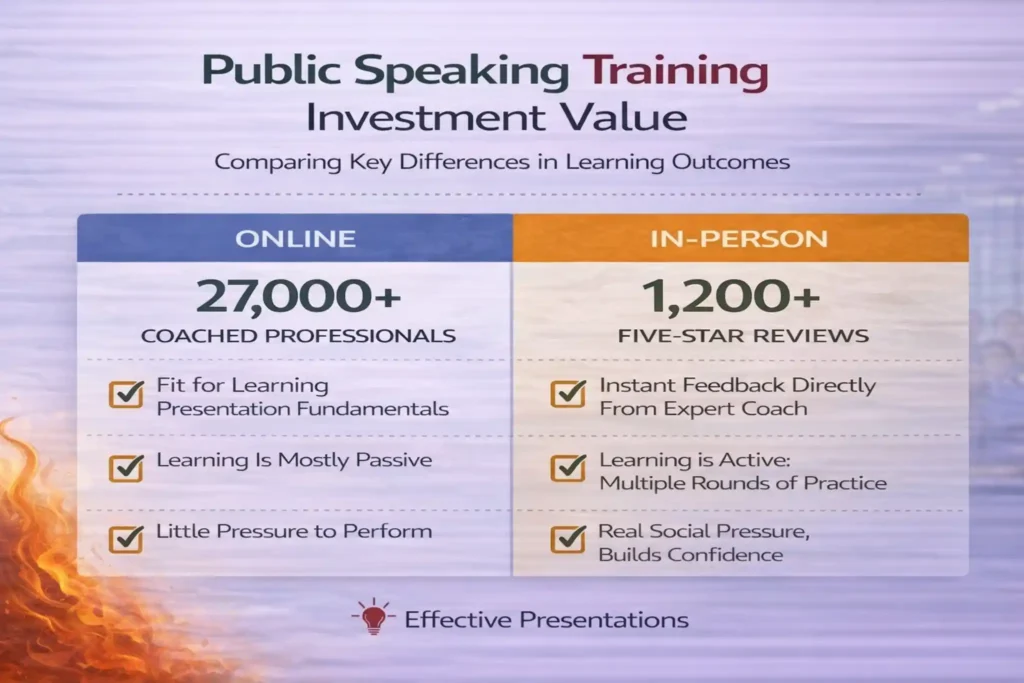
Live, in-person practice in front of a real group activates the stress response your body experiences when presenting. That is precisely where the learning happens. Research on practice conditions and performance transfer consistently shows that skills practiced in conditions that match the real performance environment transfer more reliably than skills practiced in lower-stakes simulations.
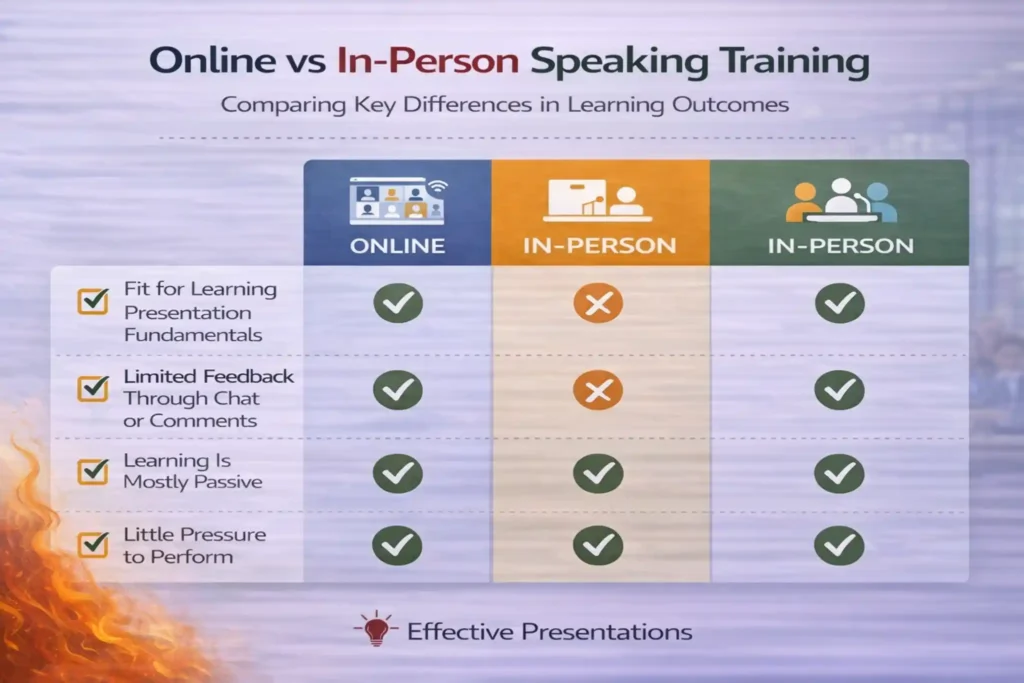
Online training can work when it is structured correctly: live sessions, cameras on, real practice in front of a coach and peers, and specific delivery feedback. A recorded video course you watch at your desk is not training. It is information. The two are not interchangeable. Our virtual presentation training is built around live, coached interaction for exactly this reason. Passive online content does not improve coached delivery.
The right choice depends on your schedule, learning style, and training goals.
| Feature | In-Person Training | Virtual Training |
| Learning Environment | Face-to-face interaction in a classroom or meeting room setting | Join from anywhere with an internet connection |
| Audience Experience | Practice presenting to people in the same room | Practice presenting on camera to a live audience |
| Feedback | Immediate feedback from coaches and participants | Real-time feedback through live coaching sessions |
| Team Participation | Great for teams working in the same location | Ideal for remote and hybrid teams |
| Convenience | Requires travel and scheduling coordination | No travel required, making participation easier |
| Networking Opportunities | More opportunities for in-person conversations | Limited but still allows interaction with participants |
| Best For | Organizations that want hands-on group learning | Busy professionals and distributed teams |
Choosing Based on Where You Are Right Now
The right program depends on what you actually need, not on which name is most recognizable.
If you are an individual professional who needs to build confidence presenting to internal teams, leadership, or clients, our presentation skills training is built for exactly this situation. It is what we have been doing for 20-plus years with professionals at every level.
If you are a senior executive whose communication directly affects how your organization performs, individual executive coaching working around your specific material and context will produce faster results than any group program.
If you are responsible for a team where everyone needs to communicate better, from the sales force to the technical leads, our corporate workshop model delivers that across the whole group, in one room, with individual coaching for each person in the session.
What you should not do is buy a recorded online course and expect it to deliver what live, coached practice produces. The investment in the course is smaller. So is the outcome.
Getting Real Value From Any Training Investment
One coached session builds awareness. Sustainable improvement comes from practice over time.
Going through training and then not presenting publicly for three months resets much of what you built. The professionals we have coached who see the most lasting improvement are the ones who integrate training into their actual work: they complete a workshop, they present at the next available opportunity, they request honest feedback from someone watching, and they return for coaching on what showed up. That cycle is where real confidence is built, not in the training room alone.
If anxiety is the thing holding you back from taking the first step into training, our guide on how to calm nerves before a speech covers the specific techniques we use with clients before every workshop begins.
What Happens During Public Speaking Training?
One of the biggest reasons people hesitate to sign up for public speaking training is that they don’t know what to expect.
Many imagine being forced to give a speech in front of a room full of strangers while everyone judges them.
In reality, effective training is designed to help people improve gradually in a supportive and encouraging environment.
Step 1: Understanding Your Strengths and Challenges
Every participant starts at a different place.
Some people struggle with nervousness. Others speak too quickly, rely heavily on notes, or have trouble organizing their thoughts. Some are already comfortable speaking but want to become more polished and engaging.
That’s why the first step is understanding where you are today.
For example, a sales professional may need help handling client presentations, while a manager may want to feel more confident leading meetings.
An executive may be preparing for a board presentation or keynote speech.
Step 2: Getting on Your Feet and Speaking
The fastest way to improve public speaking is to actually do it.
After all, you can’t learn to swim by reading about swimming, and you can’t become a confident speaker by only watching videos or reading books.
During training, participants are given opportunities to stand up and present in a supportive environment.
Depending on the program, this may involve delivering a short presentation, introducing themselves, explaining a project, or practicing a real presentation they need to give at work.
For many participants, this is the moment they realize they are far more capable than they thought.
Nobody expects flawless presentations. The goal is to gain experience, identify opportunities for improvement, and become more comfortable speaking in front of others.
Step 3: Receiving Personalized Coaching and Feedback
This is where real growth happens.
After each presentation, participants receive specific feedback from experienced coaches.
Instead of hearing general comments like “good job” or “you need more confidence,” participants receive practical guidance they can immediately apply.
Because the feedback is personalized, participants know exactly what to work on and how to improve.
Learning through practice is important because communication is a performance skill.
Research from Harvard Business Review shows regular practice and constructive feedback can help people build confidence, improve communication skills, and become more effective speakers over time.
Step 4: Making Adjustments and Trying Again
One of the biggest differences between effective training and traditional workshops is the opportunity to practice improvements right away.
Many training programs provide information, but never give participants a chance to apply it.
Our approach is different.
After receiving coaching, participants return to the front of the room and practice again. They apply the suggestions, test new techniques, and begin building better speaking habits.
For example, if a participant tends to speak too quickly, they may practice slowing down and using pauses more effectively. If someone struggles with audience engagement, they may work on eye contact, storytelling, or asking questions.
Step 5: Building Confidence Through Repetition
The more opportunities people have to speak, receive feedback, and improve, the more comfortable they become.
Many participants arrive feeling nervous about speaking in front of a group. By the end of training, they often discover that public speaking feels much less intimidating than it once did.
This happens because they have practiced in a safe environment, learned proven techniques, and gained experience handling situations that once made them uncomfortable.
5 Common Public Speaking Mistakes That Hold People Back
Before choosing a training program, it helps to understand some of the most common mistakes speakers make.
1. Trying to Memorize Every Word
Many people try to memorize their presentation word for word. The problem is that if they forget one sentence, they often lose their place and become more nervous.
For example, a manager giving a quarterly update may panic after forgetting a single line, even though they know the topic well.
It’s usually better to focus on key points rather than memorizing every word.
2. Speaking Too Quickly
When people feel nervous, they often rush through their presentation without realizing it.
For example, a sales professional might speed through an important proposal because they are anxious about being judged.
Slowing down helps your audience follow along and gives you more time to think.
3. Reading Directly From Slides
Slides should support your message, not become your script.
Imagine sitting through a presentation where the speaker simply reads every word on the screen. Most audiences quickly lose interest.
People want to hear your insights, not watch you read.
4. Avoiding Eye Contact
Eye contact helps build trust and keeps your audience engaged.
For example, a team leader who constantly looks at their notes may appear unsure of themselves, even if they know the material well.
Looking at different people throughout the room helps create a stronger connection.
5. Not Practicing Out Loud
Many presenters prepare by reading silently, but presentations sound very different when spoken aloud.
For example, a presentation that looks perfect on paper may feel awkward or too long when practiced out loud.
Speaking through your presentation beforehand helps you improve timing, wording, and delivery before the big day.
Frequently Asked Questions: Public Speaking Training Programs
What should I look for in a public speaking training program?
Look for four things: real-time practice in front of others, not solo rehearsal; video feedback so you can see what your audience sees; specific, technical coaching that identifies exactly what is not working; and multiple sessions over time rather than a single-day event. Programs that combine these four elements produce lasting improvement. Programs missing any of them produce awareness without skill change.
How long does it take to improve at public speaking?
Most professionals see measurable, visible improvement within three to five coached sessions that include real practice and specific feedback. Foundational confidence shifts happen faster than most people expect. Long-term mastery comes from continued practice over months and years. The single most reliable accelerator is coached, video-reviewed practice in front of a real group, repeated regularly.
Is online public speaking training as effective as in-person?
Live online training with cameras on, real practice, and real-time coaching from an expert can be highly effective. Recorded video courses are not training. They are information. The distinction matters because public speaking is a performance skill that requires practicing under the actual stress conditions of being seen and evaluated by others. Passive content does not replicate those conditions.
What is the difference between public speaking training and presentation skills training?
In practice, they address the same core skill: communicating effectively in front of an audience. Public speaking training often emphasizes the delivery dimension: voice, body, anxiety management, and audience connection. Presentation skills training typically also addresses message structure, slide design, and the professional context of business communication. The best programs address both dimensions because delivery without substance and substance without delivery both fail the audience.
How do I know if a public speaking training program is worth the investment?
The clearest indicator is specificity of feedback. Programs that give you general principles and send you home to practice are selling information. Programs that watch you present, identify precisely what is not working, coach you on those specific elements, and have you practice again immediately are building skill. Ask the program directly: what does a session look like, who delivers the coaching, and how is feedback given? The answers tell you what you are actually buying.
