
Public Speaking for Leaders: How Great Leaders Communicate With Confidence

Public speaking is one of the most critical skills a leader can develop. Leaders use it every day to inspire teams, influence stakeholders, communicate vision, and drive action.
Effective leadership communication goes beyond presenting well. It requires executive presence, clear messaging, audience awareness, and confident delivery.
And it demands a different skill set than general public speaking because what you say as a leader shapes decisions, culture, and the direction of your entire organization.
At Effective Presentations, we help leaders at every level develop exactly those skills, through executive coaching, customized training, and real-world practice that build lasting confidence and influence.
Leadership and Public Speaking Are Closely Connected!
Every leader communicates publicly, whether they realize it or not.
In a town hall, you are setting the tone for your entire organization. In a board presentation, you’re building or eroding credibility with the people who hold the most influence over your company’s future. In a team meeting, your words either energize or deflate the people executing your strategy.
Leadership and public speaking are inseparable because speaking is how leaders lead.
When leaders communicate well, trust builds. Teams align. Stakeholders follow.
Leaders regularly face:
- Communicating change, delivering difficult news without derailing morale
- Speaking under pressure, staying composed when the room is skeptical
- Executive presentations, influencing senior stakeholders who have little time and high standards
- Town hall meetings, engaging an entire organization across functions and levels
- Board presentations, demonstrating command, not just competence
- Difficult conversations, delivering honest messages with clarity and care
None of these are cases where “winging it” works. They need deliberate communication skills, and most leaders never formally develop them.
How Does Public Speaking Impact Leadership Effectiveness?
Good public speaking makes leaders more effective. This is how it shows up in real leadership situations.
Employee Engagement
When a leader communicates clearly and honestly, employees feel informed and valued. When communication is vague or inconsistent, people disengage.
A manager who explains why a new process is changing, not just what is changing, gets a team that buys in. A manager who just sends a memo gets a team that complains in the break room.
Leaders who hold regular team meetings, give clear updates, and speak openly about challenges create workplaces where people actually want to show up.
Stakeholder Confidence
Every time you present to a board, pitch to an investor, or speak to a client, they are quietly evaluating you. Not just your ideas, but you. Your confidence, your clarity, your ability to answer hard questions.
A CEO who walks into a board meeting prepared, composed, and clear builds confidence in the room. One who fumbles through slides or avoids direct answers raises doubts even if the business is performing well.
Strong public speaking skills help leaders earn trust faster and hold it longer.
Decision Influence
Big decisions rarely come down to one person. They come down to who made the most compelling case in the room.
If you can explain your idea clearly, back it up with the right data, and tell a story that makes it real, people listen. If you can’t, even a great idea gets passed over.
A product leader who can walk a skeptical executive team through a business case, simply, confidently, with a clear recommendation, is far more likely to get the green light than one who overwhelms the room with detail.
Organizational Alignment
When leaders don’t communicate strategy clearly, teams start guessing. And when teams guess, they go in different directions.
A simple example: if a sales team hears one version of the company’s priorities and the marketing team hears another, they’ll build campaigns and pipelines that don’t connect. That costs time, money, and momentum.
Clear, consistent communication from leadership keeps everyone moving toward the same goal.
Leadership Presence
Presence isn’t about being loud or charismatic. It’s about how you carry yourself when you speak, your confidence, your eye contact, your ability to hold a room’s attention, and make people feel that what you’re saying matters.
And it’s not something you are born with. It’s a skill you build.
A leader who walks into a difficult conversation calm and composed, who listens, responds thoughtfully, and speaks with authority, creates a very different impression than one who seems uncertain or unprepared.
Executive presence is one of the most powerful outcomes of good public speaking training.
5 Top Communication Skills Every Leader Needs
Great leaders aren’t just good at their jobs, but they are also good at communicating about their jobs. These are the five skills that make the biggest difference.
1- Message Clarity
The most common leadership communication failure isn’t saying the wrong thing. It’s saying too much and losing the point.
Strong leaders know how to simplify complex ideas into clear, purposeful messages.
Before you speak, ask: What do I want my audience to understand, feel, or do after this? Everything else is noise.
2- Executive Presence
Presence is built on three pillars: confidence, authority, and authenticity.
Confidence is how you carry yourself.
Authority comes from your command of content and context.
Authenticity is what makes people trust you rather than just respect your title. Leaders who have all three don’t just speak, they lead rooms.
Forbes notes that executive presence consistently ranks among the top qualities boards and senior stakeholders look for when evaluating leadership potential.
3- Storytelling
Data informs. Stories persuade. The most effective leaders know how to frame their messages in narratives that stick.
They connect the numbers to real impact. They make strategy feel human. Storytelling isn’t a soft skill; it’s what makes hard messages land.
4- Audience Awareness
Who are you speaking to, and what do they need from you?
A boardroom requires different communication than a company all-hands. A skeptical stakeholder needs a different approach than an aligned team.
Great communicators read the room and adapt, without losing their message.
5- Active Listening
Communication isn’t just what you say. Leaders who listen actively, who respond thoughtfully, acknowledge what they have heard, and ask the right questions, build deeper trust and create more productive dialogue. Listening is part of speaking well.
Public Speaking Skills for Managers and Emerging Leaders
Leadership communication skills matter at every level, not just in the C-suite.
Leading Team Meetings
Meetings are one of the most visible leadership communication moments.
Run them with clarity, structure, and energy, and your team will be more aligned and productive. Let them drift, and you lose both time and credibility.
Giving Direction Clearly
Ambiguous direction creates ambiguous results.
Managers who communicate expectations, priorities, and context clearly get better performance, because their teams know exactly what’s expected and why it matters.
Presenting Ideas to Senior Leadership
Moving up in an organization often depends on your ability to present upward effectively.
That means getting to the point, anticipating objections, and framing your ideas in terms that resonate with executive priorities.
Handling Difficult Questions
Q&A sessions reveal how prepared and how confident a leader really is.
Knowing how to handle a curveball, stay composed under pressure, and respond without over-explaining is a skill that earns respect in the room.
Building Confidence as a New Leader
New leaders often feel the gap between their authority and their confidence. Public speaking skills close that gap faster than almost anything else.
When you learn to communicate with conviction, you start to be perceived and to see yourself as a leader.
Executive Public Speaking Training: 6 Skills Leaders Need Most
Senior leaders face communication situations that carry significant consequences.
The right training is focused, practical, and built around the scenarios that matter most.
Boardroom Presentations
Board members expect clarity, brevity, and command.
They want you to get to the point, anticipate their concerns, and handle hard questions without flinching. Executive communication coaching helps leaders show up to the boardroom, not just prepared, but polished.
Investor Presentations
The ability to inspire confidence in a room of skeptical, analytical stakeholders is a high-stakes communication skill.
Investor presentations require precision, compelling narrative, and unshakeable composure.
Town Hall Communication
Town halls are your most visible leadership communication moment. Done well, they build trust, clarity, and connection across your organization.
Done poorly, they create confusion and erode confidence. Leaders who can energize and inform an entire organization are rare and invaluable.
Media and Public Appearances
On-camera presence, interview skills, and public messaging require a specific communication skill set.
Leaders who haven’t trained for these situations often discover the gap at the worst possible time.
High-Stakes Business Presentations
Whether you’re pitching a major client, defending a budget, or presenting a strategic recommendation, high-stakes presentations demand more than good slides.
They require a leader who can command the room, handle resistance, and close with conviction.
Personalized Coaching and Feedback
Generic training rarely sticks.
The most effective executive communication development is one-on-one, built around your specific communication strengths, gaps, and the actual situations you face.
6 Leadership Presentation Skills That Drive Results
A great idea poorly presented rarely goes anywhere. These six skills help leaders communicate with the clarity and confidence that turns presentations into decisions.
1- Structuring Executive Presentations
Senior leaders are busy. They don’t have time for long build-ups or presentations that take ten minutes to get to the point.
The most effective structure is simple: start with your conclusion, back it up with the evidence that matters most, and close with a clear recommendation. Don’t save the big idea for the end, but lead with it.
2- Presenting Data Persuasively
Data doesn’t make your case, you do. Throwing numbers on a slide isn’t the same as making an argument.
The leaders who win rooms are the ones who can look at a chart and say: here’s what this means for us, and here’s what we should do about it. They connect the data to a decision. They make it relevant to the people in the room.
3- Creating Clear Calls to Action
Every presentation needs to end with one clear answer to this question: what happens next?
Are you asking for a decision? Budget approval? Team alignment? Say it directly.
Leaders who close with vague language like “just wanted to share some thoughts” walk out of rooms without momentum. Leaders who close with “I need a yes or no by Friday” walk out with one.
4- Communicating Strategy
Most strategy presentations fail for the same reason: they’re too long, too dense, and too abstract for the audience to act on.
A strong strategy presentation answers three questions simply: What are we doing? Why does it matter? What does success look like? Everything else is a detail that can live in a document.
When people leave a strategy presentation knowing exactly what they’re supposed to do differently, that’s when it worked.
5- Managing Executive Q&A Sessions
Q&A is where your credibility is tested.
How you handle a tough or unexpected question tells the room more about your leadership than anything on your deck.
The best leaders listen fully before responding. They answer directly. And when they don’t know something, they say so, without apologizing for it.
Composure under pressure is a credibility signal. Practice it like any other skill.
6- Leading Virtual Presentations
Virtual settings create new communication challenges that require deliberate solutions.
Look into the lens, not the screen. That’s where your eye contact goes. It’s a small shift that makes a significant difference in how present you seem.
Use your voice more deliberately. Energy drops on camera. Speak with slightly more range and intention than you would in person, without overdoing it.
Don’t assume people are following your screen. When you share visuals, walk the audience through them out loud. Pause. Point. Narrate.
Create moments of participation. Use names. Ask direct questions. Build in checkpoints. Silence on a video call feels much longer than silence in a room; fill it with purpose.
Keep it tighter than you think you need to. Virtual attention spans are shorter. Cut anything that isn’t essential.
How Effective Presentations Help Leaders Become Better Communicators?
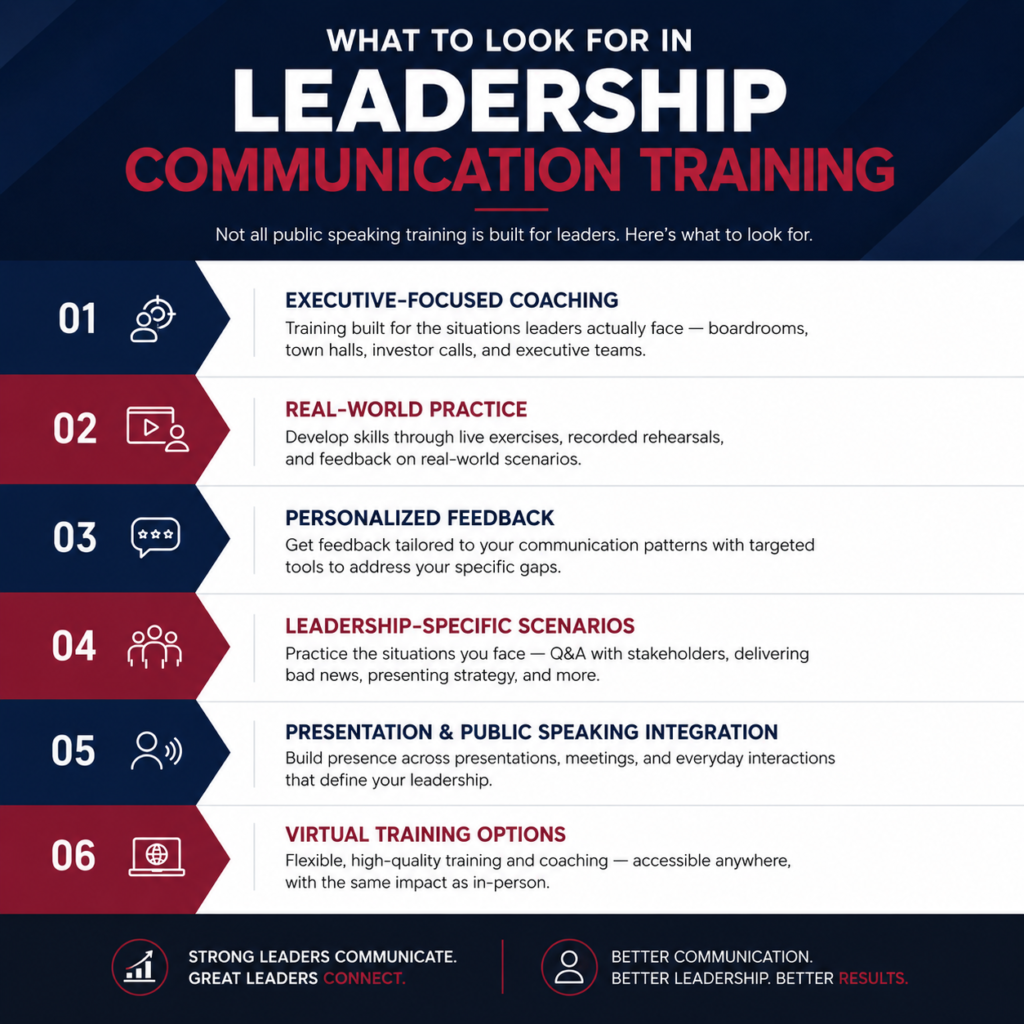
Effective Presentations works with leaders at every level, from managers stepping into their first executive role to C-suite leaders preparing for major public moments.
Leadership Communication Training
Most leaders are never formally taught how to communicate. Leadership communication training program changes that.
We build the foundational skills that make every leadership interaction more effective, including message clarity, executive presence, audience engagement, and storytelling.
Executive Public Speaking Training
For senior leaders, the stakes are too high for generic training.
Our executive public speaking programs are built around the situations you face, boardroom presentations, investor meetings, media appearances, and company-wide communication, with coaching intense enough to move the needle fast.
Presentation Skills Development
We help leaders develop every dimension of presentation effectiveness, from how you structure your argument and use visuals, to how you open, close, and hold a room’s attention from start to finish.
Executive Coaching
One-on-one. Focused entirely on you.
Our executive coaches work with your actual material, your specific communication habits, and the real presentations you have coming up, then give you the direct, personalized feedback that drives lasting change.
Customized Corporate Programs
Our corporate programs are built from scratch around your leadership team, your industry, and the communication gaps holding your people back, whether that’s presenting to the board, leading through change, or communicating across a global workforce.
Develop Stronger Leadership Communication Skills!
The way you communicate determines how effectively you lead, in the boardroom, the town hall, the team meeting, and every high-stakes moment in between.
Effective Presentations offers 1-on-1 executive coaching built around you, your material, your audience, and the specific presentation that matters most right now.
We have trained 100,000+ professionals over 20+ years, and we are America’s most-reviewed presentation training company, with 1,200+ five-star Google reviews to back it up.
Book your 1-on-1 Coaching Session or call us: 800.403.6598.
People Also Ask
How can leaders improve public speaking skills?
Through deliberate practice, targeted feedback, and scenario-specific training. Reading about communication helps. Watching great communicators helps. But the fastest path to improvement is practicing in conditions that mirror the situations you actually face, with coaching that tells you specifically what to do differently.
What are the most important communication skills for leaders?
Message clarity, executive presence, storytelling, audience awareness, and the ability to handle pressure moments, Q&A, difficult conversations, and high-stakes presentations with composure and confidence.
What is executive public speaking training?
It’s leadership-focused communication coaching designed around the specific situations senior leaders face: boardroom presentations, investor communications, town halls, media appearances, and high-stakes business presentations.
How do leaders speak with confidence?
Through preparation, practice, and the kind of repetition that builds real competence. Confidence follows competence, and both grow fastest with skilled coaching and structured feedback.
Can public speaking improve leadership effectiveness?
Consistently, yes. Leaders who communicate well build stronger teams, influence decisions more effectively, and are perceived as more capable, which accelerates their organizational impact.
What makes a great leadership communicator?
The ability to be clear, compelling, and credible, in any room, under any conditions. Great leadership communicators don’t just deliver information. They make people want to act on it.
What is leadership communication training?
It’s a structured development program designed to build the communication skills leaders need most, from executive presence and message clarity to high-stakes presentation skills and virtual communication effectiveness.
