
Public Speaking Tips to Calm Nerves (2026)
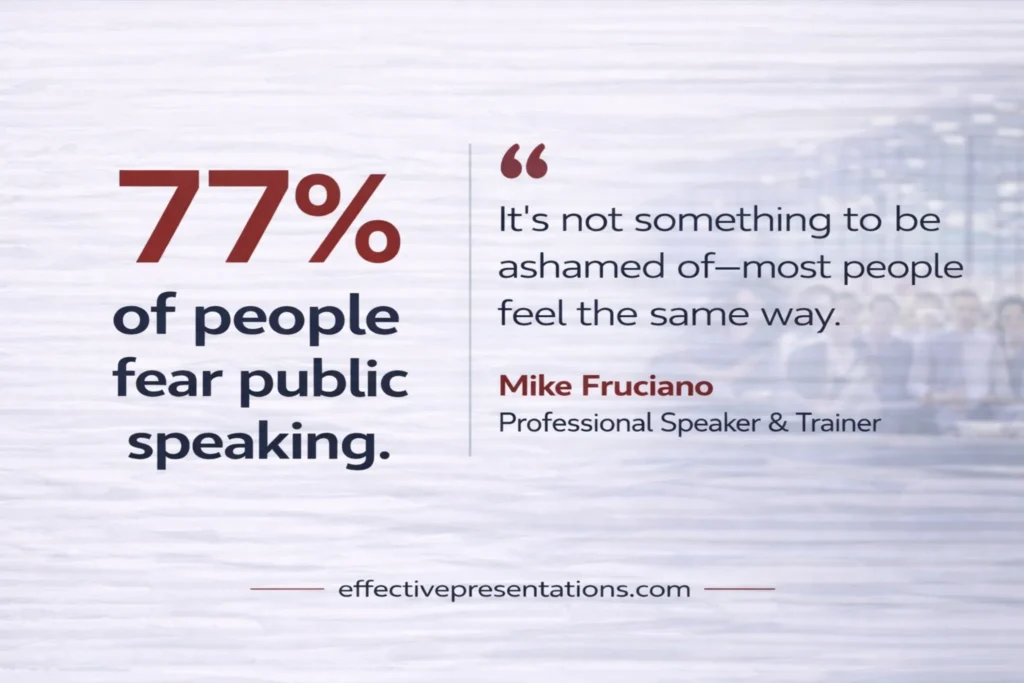
Approximately 77% of the general population experiences fear of public speaking, according to research published in Neuropsychiatric Disease and Treatment. That number has held steady for decades. The fear of speaking in front of others is not a personality flaw or a sign that you are not ready. It is a neurological response to perceived social risk, and it is one of the most trainable reactions in professional life. The speakers who appear calm in front of 300 people are not wired differently. They have learned specific techniques to manage what their body does under pressure, and those techniques can be taught, practiced, and made automatic. At Effective Presentations, we have spent 20 years coaching thousands of professionals through exactly this process, from Fortune 500 executives to first-time presenters who could barely finish a sentence in front of a room.
This is not a list of generic advice. These are the methods we use in our workshops every week.
Why Your Body Fights You Before a Speech
Your nervous system does not distinguish between a quarterly business review and a physical threat. When you stand in front of a group, your brain activates the same fight-or-flight response it would use if you stepped into traffic. Heart rate spikes. Palms sweat. Your mouth goes dry. Your voice tightens.
None of that means you are failing. It means your body is doing exactly what evolution designed it to do.
The problem is that most advice tells you to “just relax.” That instruction is useless when your sympathetic nervous system is already activated. What works is redirecting that activation, not suppressing it.
The Six Triggers We See Most Often
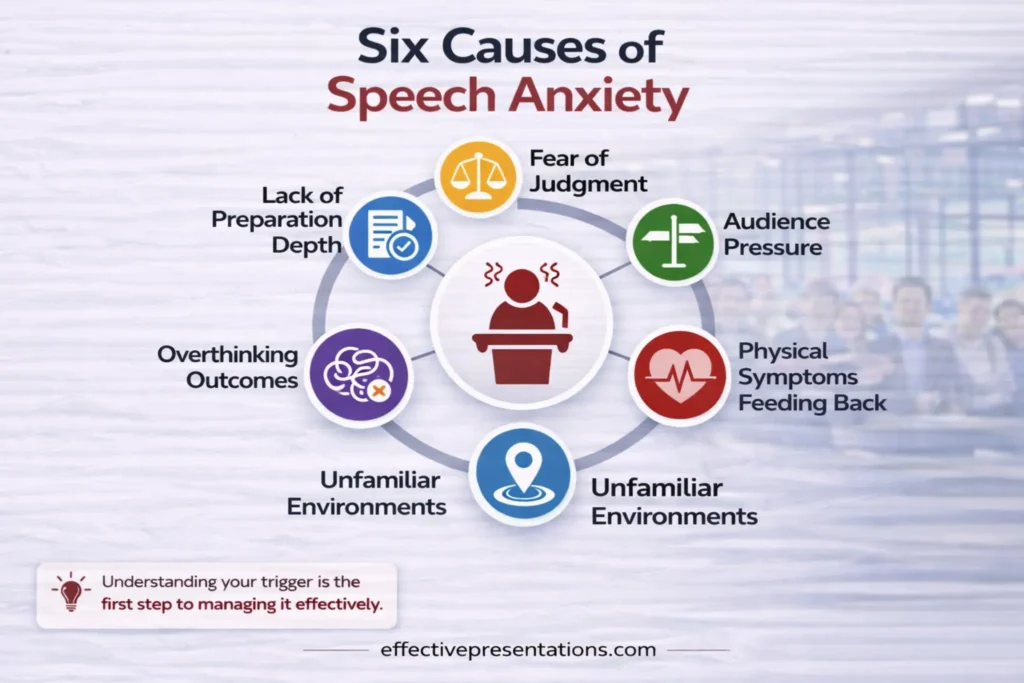
After coaching thousands of presenters, we have identified six triggers that account for nearly every case of speech anxiety we encounter:
Fear of judgment. This is the most common. The speaker is not afraid of the content. They are afraid of what the audience thinks of them personally.
Lack of preparation depth. Not surface preparation. Deep preparation. Knowing your material at a level where someone could interrupt you at any point and you could pick up without notes.
Overthinking outcomes. Spiraling into worst-case scenarios before the presentation even begins. The speech fails in the speaker’s head long before it fails in reality, if it fails at all.
Audience pressure. Larger groups amplify perceived stakes. A room of 10 feels manageable. A room of 200 feels like judgment at scale.
Physical symptoms feeding back. A racing heart makes you think something is wrong, which makes your heart race faster. The loop is self-reinforcing.
Unfamiliar environments. New rooms, new technology, new audiences. Anything that adds uncertainty adds anxiety.
A separate prevalence study in Frontiers in Human Neuroscience found that approximately 63% of the general population report experiencing some level of public speaking anxiety (Marinho et al., 2017). Understanding your specific trigger is the first step to managing it, because each trigger responds to a different technique.
Prepare Like a Professional Speaker
Most people overprepare the slides and underprepare themselves. That is why they still feel unprepared walking in.
We coached a Senior Director at a Fortune 100 technology company who could walk us through her entire 40-slide deck from memory. Every statistic, every transition. In the first out-loud rehearsal with one of our coaches, she hit a wall at slide 12. Not because she did not know the content. Because her mouth had never said those words in that sequence under real-time pressure.
That is the gap most preparation strategies miss entirely.
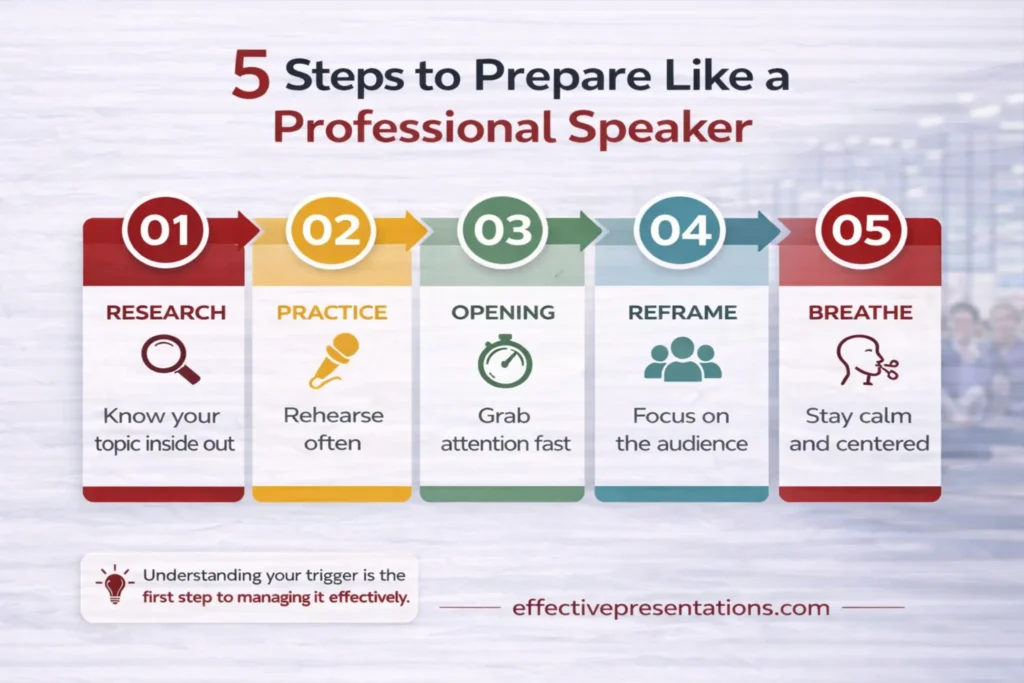
1. Research Your Topic Beyond the Slides
Knowing your slides is not knowing your topic. If someone asked you a question that is not on any slide, could you answer it with authority? That depth of knowledge is what creates psychological safety before you speak. When you know more than you need to present, the presentation feels smaller than your expertise. That is the feeling you want.
2. Practice Out Loud, Not in Your Head
Your brain processes language differently when you are producing it versus reviewing it. Reading words silently is recognition. Saying them out loud is performance. Those are not the same skill, and you cannot train one by practicing the other.
Three out-loud rehearsals will do more for your delivery than thirty silent read-throughs. We build this directly into our presentation skills training because it is the single most undertrained element of preparation. If you want to understand why silent rehearsal fails, our piece on why memorizing your speech is the wrong approach breaks down the same problem from a different angle.
3. Structure Your Opening Cold
Your first 30 seconds are the highest-anxiety moment of any presentation. When you know your opening absolutely cold, not “pretty well,” cold, you give your nervous system a chance to settle before your body catches up. The first 30 seconds either break the anxiety spiral or feed it.
We tell every client: rehearse your opening until it is automatic. Not memorized in a brittle, scripted way. Automatic, so that even if your heart rate spikes when you walk in, the words come out clean. Our work on messaging and structure starts here, because how you organize your opening determines how confidently you deliver everything after it.
4. Anticipate the Three Hardest Questions
For many speakers, Q&A is the highest-anxiety moment because it feels uncontrollable. It is not. Identify the three toughest questions someone could ask and prepare clear frameworks to answer them. When the hard question comes, you recognize it, and you have a path. That preparation converts uncertainty into composure.
5. Visit the Room Before You Speak
Unfamiliar environments activate your alert system. Walk the room before the audience arrives. Stand where you will present. Test the microphone. Check the screen. Touch the podium. Your brain needs to categorize the environment as “known” before it will let your body relax in it.
Mental Techniques That Actually Work Under Pressure
Positive thinking is fine. Specific mental techniques are better. These are the ones we coach because they produce measurable changes in how our clients perform.
Shift from Self-Focus to Audience-Focus
Most anxious speakers are focused entirely on themselves. What they look like. Whether they are stumbling. Whether people are judging. The shift from self-focus to audience-focus is the single most powerful move in public speaking training.
Ask yourself before you walk in: What does this audience need to leave here knowing? The moment you are genuinely engaged with that question, there is no mental space left for self-conscious anxiety.
We coached a Senior Director at a Fortune 100 company who was almost physically ill before her quarterly all-hands. Three hundred people. Live-streamed globally. We did not fix her breathing first. We fixed her framing. She started thinking about what her team needed to hear to go into the quarter with confidence. Her anxiety dropped by half in the first session, not because the room got smaller, but because her focus shifted.
Reframe Nerves as Activation, Not Failure
A study published in the Journal of Experimental Psychology: General found that reappraising anxiety as excitement improved public speaking performance more effectively than attempts to calm down (Brooks, 2014). Participants who told themselves “I am excited” before presenting were rated as more persuasive, more competent, and more confident than those who tried to relax. The physical sensations are identical. The difference is the label you assign them.
When your heart rate rises before a presentation, that is your body preparing to perform. The professionals who present well under pressure have not eliminated that response. They have reframed it. “I am nervous” becomes “I am activated.” Same body, different interpretation, measurably different outcome.
Visualize the First Two Minutes, Not the Whole Speech
Full-speech visualization is too abstract to be useful. Instead, visualize walking to the front of the room, making eye contact with one person, and delivering your opening paragraph. Make it specific: what does the room look like, where are your hands, what does your voice sound like? Specificity is what makes visualization effective, not duration.
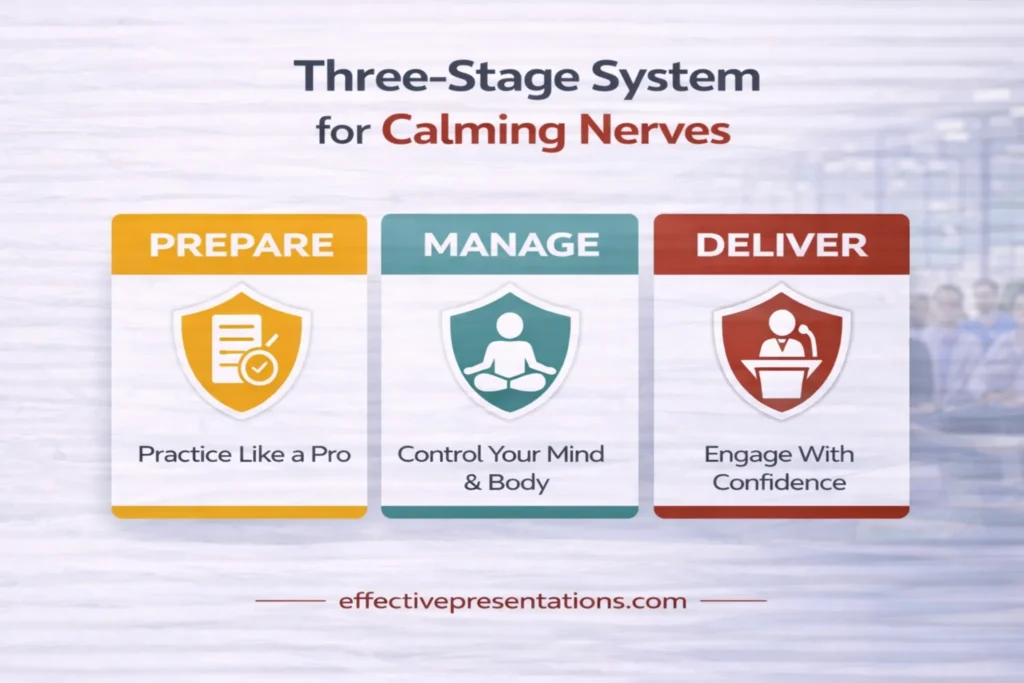
Physical Strategies That Reduce Anxiety in Minutes
Controlled Breathing: The 60-Second Reset
Four-count inhale. Four-count hold. Four-count exhale. Done for 60 seconds immediately before you take the floor, this measurably lowers heart rate and shifts your nervous system out of threat mode. This is not a relaxation exercise. It is a physiological override.
Research published in Frontiers in Psychology demonstrated that diaphragmatic breathing significantly lowered cortisol levels and improved sustained attention, confirming that controlled breathing creates a measurable shift toward parasympathetic activation (Ma et al., 2017).
Use Your Body Before You Speak
Posture affects neurochemistry. Standing open and upright for two minutes before you present changes your hormone levels in ways that directly reduce cortisol. Before you walk in, plant your feet. Roll your shoulders back. Breathe from your diaphragm. You are not performing confidence. You are triggering the physiological state that makes it possible.
Light Movement Breaks the Freeze Response
A brisk walk for five minutes before presenting releases enough endorphins to noticeably reduce tension. If you are sitting in a conference room waiting for your turn, stand up. Walk to get water. Move. Static waiting feeds anxiety. Movement interrupts it.
What to Do in the Final Five Minutes
Arrive 15 minutes early. The room should feel like yours before anyone else walks in.
Greet three people before you start. This converts the audience from strangers to people you have spoken with. That single shift reduces the psychological distance between you and the room.
Check your technology. Every piece of it. Clicker, slides, microphone, video. One unexpected technical failure during the opening can cascade into full anxiety activation for the entire presentation.
Run your opening once, out loud, in the empty room. This is the final rehearsal that matters most. Your voice hearing itself in that specific space is the last piece of environmental familiarization your brain needs.
Building Long-Term Speaking Confidence
Quick techniques manage a single presentation. Long-term confidence comes from deliberate practice with expert feedback over time.
Record yourself and watch it. Not to criticize. To observe. You will immediately identify three things that need to change, and that knowledge alone cuts anxiety significantly, because now you are solving real problems instead of fearing imaginary ones.
Get professional coaching. The fastest development happens with a coach who watches you present, identifies exactly what is not working, and holds you to a higher standard the next time you step up. Our 1-on-1 coaching is built around this model because it produces results that group settings alone cannot match.
Join a structured training environment. Regular reps in front of real people, with real feedback, under progressively harder conditions. That is what builds composure. Our upcoming workshops are designed around this exact principle.
The 1,200+ five-star reviews we have accumulated did not come from people who walked in confident. They came from people who walked in terrified and walked out knowing exactly what to do the next time they faced a room.
Frequently Asked Questions
How do I calm my nerves quickly before a speech?
The fastest technique is controlled breathing: a four-count inhale, four-count hold, four-count exhale for 60 seconds. This directly lowers heart rate by activating the parasympathetic nervous system. Pair that with reframing your nerves as activation rather than failure, and you have a two-step system that works in under two minutes.
Why do I get so nervous before public speaking?
Your brain treats public speaking as a social threat, activating the same fight-or-flight system it uses for physical danger. The six most common triggers are fear of judgment, insufficient preparation depth, overthinking outcomes, audience size pressure, physical symptom feedback loops, and unfamiliar environments. Identifying your specific trigger is the key to choosing the right management technique.
What is the best way to prepare for a speech?
Research your topic beyond the slides, practice out loud (not silently), structure your first 30 seconds until they are automatic, anticipate the three hardest questions, and walk the room before the audience arrives. This five-step sequence addresses both the mental and environmental factors that drive speech anxiety.
Does public speaking anxiety ever go away completely?
For most people, the activation response does not disappear entirely, and that is a good thing. A controlled level of arousal improves performance. What changes with training is your relationship to that response: it shifts from panic to energy. Professional speakers still feel activation before they present. They have simply trained themselves to use it rather than fight it.
Are public speaking classes worth the investment?
For professionals whose roles require presenting, structured training with expert feedback is the most reliable path to lasting improvement. Self-practice builds familiarity but not correction. A coach identifies what you cannot see in yourself. Our clients typically report measurable confidence improvement within three to five coached presentations.