
How to Choose a Public Speaking Course

Public speaking courses vary in how much time you spend presenting, who gives you feedback, and what happens after that feedback. Those differences matter whether you’re preparing for your first presentation or trying to understand why an experienced speaker can still lose a room.
Before choosing a course, identify what you want to change. You might need help managing nerves, holding attention, speaking to senior leaders, or making a recommendation sound convincing. Then look closely at how the course will help you work on that challenge.
I’ve coached professionals through Effective Presentations since 2004. Here are the questions I’d ask before enrolling in any public speaking course, including ours.
For details about our workshops, coaching options, and upcoming dates, visit our public speaking training page.
What a Good Public Speaking Course Actually Delivers
Most people shopping for a course want two things: to feel less nervous and to be more effective in front of a room. The programs that deliver both do it through practice, not lectures.
Research by K. Anders Ericsson on expert performance points to deliberate practice, meaning structured repetition with specific feedback, as a key part of how people improve at performance skills. Public speaking is a performance skill, so it makes sense to look for a course built around that kind of practice.
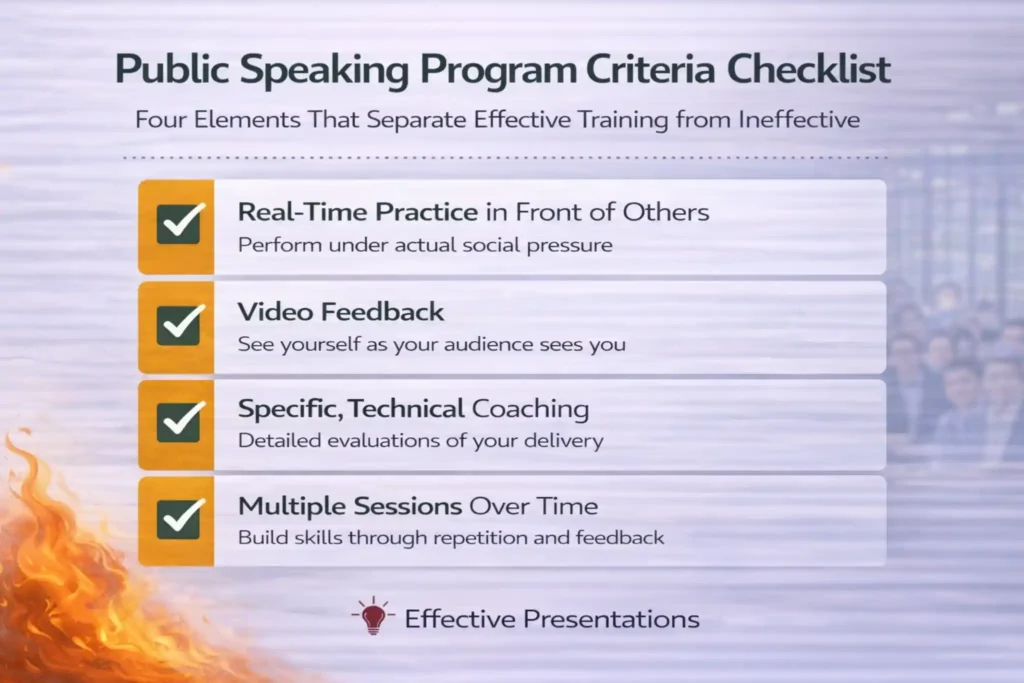
Four things to look for when comparing courses:
- Practice in front of real people. Rehearsing alone in your office is useful, but it doesn’t fully prepare you for the moment a room full of people looks up at you.
- Video of your own delivery. Most people have no accurate sense of how they look and sound when they present. Video lets you see and hear the habits your trainer is pointing out.
- Specific coaching. “Be more confident” isn’t coaching. “Your voice drops at the end of each sentence” or “your hands disappear behind the podium” is.
- Continued practice. Your first attempt shows you the problem. Presenting again with the adjustment, during the course and after it, is what starts to build the habit.
Ask for a Sample Agenda
A course description tells you what a program covers. A sample agenda shows you how the time is spent, and that is usually more revealing.
When you look at one, check how much of the day is spent presenting compared with listening. Look for blocks where participants present, get feedback, and present again, rather than a list of topics. See whether video review is built into the schedule or mentioned once.
Also check whether there is room for your own material, such as a presentation you have coming up. If a provider can’t show you an agenda, ask them to walk you through what a typical hour looks like.
Online or In Person: What Actually Matters
This usually gets treated as a convenience question. It’s really a question about practice conditions.
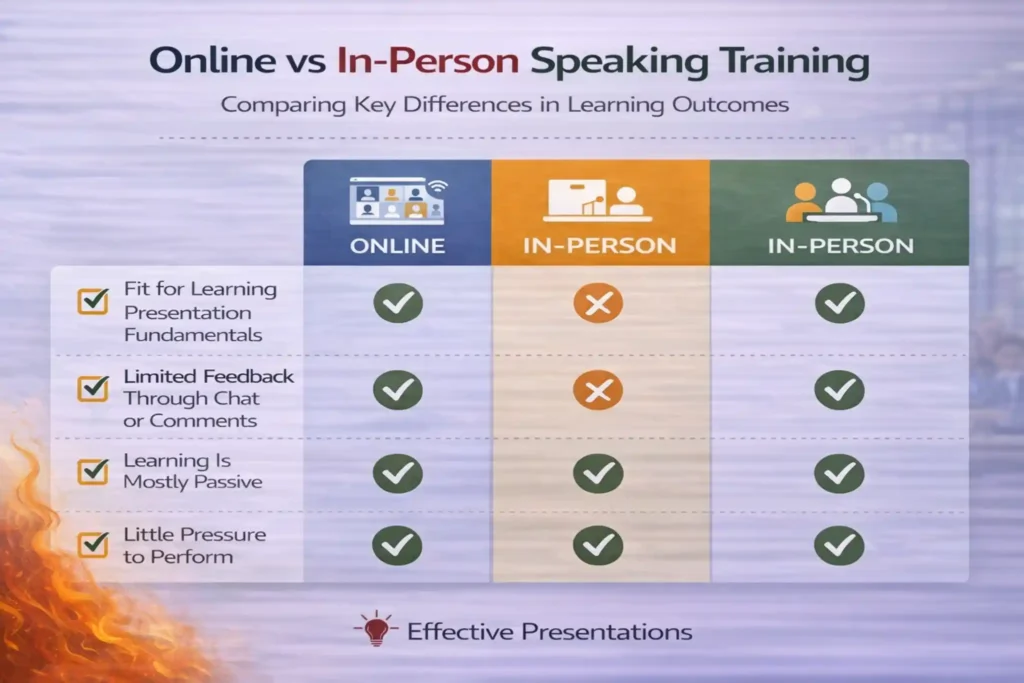
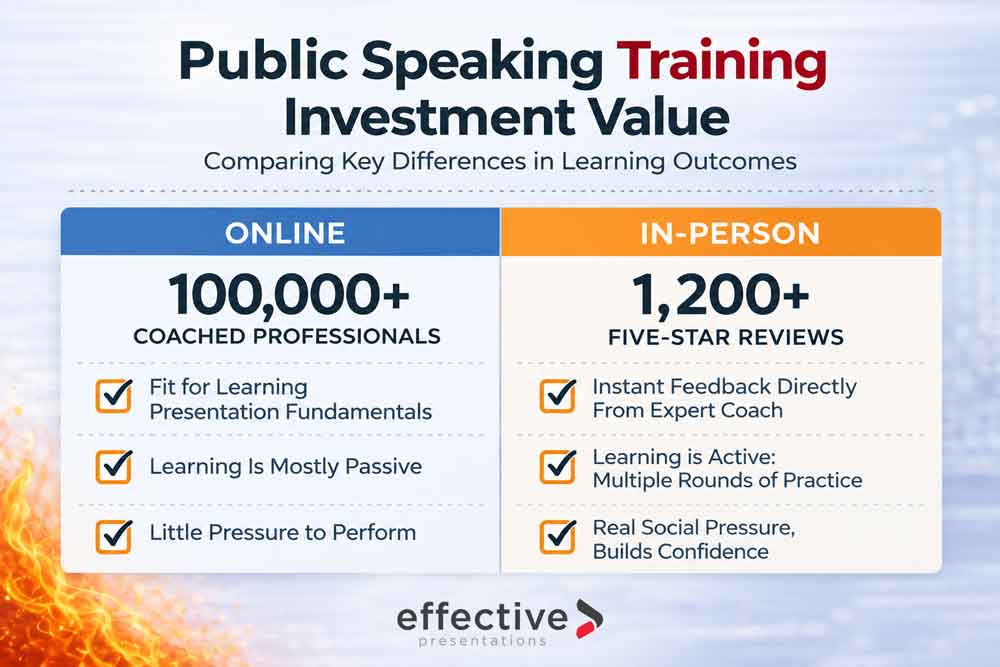
Presenting to people in the same room brings up the same nerves you feel at work, and practicing under that pressure is a big part of what makes in-person training useful.
Live online training also gives you opportunities to present, receive feedback, and try again when it’s built for practice: cameras on, real presentations in front of a coach and other participants, and feedback in the moment. Our virtual presentation training is set up that way.
Self-paced courses can help you learn and review techniques. Some also include feedback on submitted recordings. Check whether that feedback is included, who provides it, and whether you can submit another attempt.
The simplest way to choose is to think about where you actually speak. If most of your presentations happen in conference rooms, at client sites, or on a stage, in-person practice is closer to the real thing. If you present mostly on video calls, practicing on camera with live coaching may prepare you better. Many people do some of both, and either format can work when the practice is live and coached.
Group Class, Private Coaching, or Team Training
A group class gives you an audience to practice with and opportunities to learn from other people’s coaching. It can help both nervous speakers and experienced presenters who want to understand why parts of their delivery aren’t connecting.
Private coaching fits when you have a specific high-stakes presentation coming up, or one habit you want to work on with a coach’s full attention.
Team training makes sense when several people in the same organization need the same skills. The practice can be built around the situations your team actually faces, like client pitches, leadership updates, or technical briefings.
Getting Real Value From Any Training
One coached session builds awareness. Lasting improvement comes from using the skills afterward.
If you finish a course and then go months without presenting, the new habits are harder to hold onto. The people we see improve the most put the training to work right away. They volunteer for the next presentation, ask someone they trust for honest feedback, and keep practicing whatever came up.
AI practice tools can help you keep improving between coaching sessions. Our app, Eloqen.ai, gives you feedback as you rehearse, so you can make an adjustment and try again. Workshop participants receive 30 days of free access to continue practicing after class. A trainer brings another perspective, helping you understand how your delivery affects the people listening.
If nerves are what’s keeping you from signing up, our guide on how to calm nerves before a speech covers techniques you can start using now.
Questions to Ask Before You Enroll in a Public Speaking Course
Ask the provider these directly. The answers tell you whether you’re paying for practice or for information.
- How many times will I present? Ask whether you’ll present again after receiving feedback, so you can practice the adjustments.
- How much individual coaching will I get? Ask how many people are in the class and how much time each person gets with the trainer.
- Who gives the feedback, and how specific is it? A trainer who tells you exactly what to change in your voice or movement is coaching. General encouragement isn’t.
- Will I see video of myself? Most speakers misjudge how they come across until they watch themselves.
- Is the online option live or self-paced? Ask whether feedback is provided live or through a review of submitted recordings.
- How can I keep practicing after the course ends? Ask whether you keep your practice recordings and what’s available to help you keep working on your skills.
If you’d like to see how our classes answer these questions, our public speaking classes page lays out the formats, class sizes, and upcoming dates.
Frequently Asked Questions: Choosing a Public Speaking Course
What should I look for in a public speaking course?
Look for four things: practice in front of real people, video of your own delivery, specific coaching on what to change, and more than one round so you can apply the feedback. Ask how the course will help you apply feedback and keep practicing.
Is an online public speaking course as effective as in person?
Live online training with cameras on and real-time coaching can be very effective. Self-paced courses can help you learn and review techniques. Some also include feedback on submitted recordings. Check whether that feedback is included, who provides it, and whether you can submit another attempt.
How do I know if a public speaking course is worth the investment?
Look at how specific the feedback is. Some programs teach general principles and send you home to practice. Others watch you present, point out exactly what isn’t working, and have you try again on the spot. Ask what a session looks like and who gives the feedback. The answer tells you what you’re buying.
